Saturday, March 28, 2020
Tolkien's Inspirations
I noticed that a lot of the class exercises were about parallels between the reading and Tolkien's work. There are obvious elements from Prose Edda and Sir Gawain and the Green Knight that made it into Tolkien's stories that we all listed. Everyone discussed whether Tolkien had stolen these ideas outright rather than used them as mere inspiration. I think all of this relates to originality in created work. People are capable of coming up with completely new ideas, but one's experiences, memories, stories, and worldview build the framework of these ideas. Since Tolkien loved the stories so much (you'd have to love something to do a translation of it, right?), it only makes sense that he would include it in his story that he wanted his audience to love as well. He took ideas like dwarves that mine underground, and made them his own by giving them character, history, characteristics, strengths, weaknesses, and more that made them unique to Middle-Earth. What do you all think, does Tolkien steal ideas or use them as inspiration?

The Lord of the Rings, Bk2, Ch 2 The Council of Elrond, Natural Vs Unnatural/Supernatural
This is going to be a throwback to one of the exercises we did for the Hobbit. I thought it would be very interesting to do for the Lord of the rings as one thing I found really interesting about the discussion we had regarding this topic was how it could be thought of in two ways: what’s natural or unnatural to us versus what is natural or unnatural within middle-earth. What I found really intriguing for this exercise for this specific chapter is there’s a lot of unnatural things going on in middle-earth, which is why all these different people gathered for the council of Elrond.
All the uncanny things that have happened in middle-earth: The dwarves ceased receiving messages from the re-established mines of Moria, the dwarves were questioned in regards to hobbits by messengers of Mordor, there’s been an invasion of Gondor from Mordor, an Orc attack in Mirkwood is suspected to have been coordinated to aid in Gollum’s escape of the Mirkwood Elves, and Saruman has turned towards the path of power.
So much has gone south, all because of the ring, that brought the council together. Evil is hard at work disrupting the normal rhythm of the world. All these disruptions in middle-earth are the conclusive reason why the ring needs to be dealt with, and dealt with by being destroyed and that no other path besides this one is viable.
It was very interesting to look at and see how all these unnatural aspects develop further as key elements in the story later on and as an explanation for what’s occurred. The black riders pursuit of Frodo and his gang to Rivendell, the trip through the mines of Moria, Saruman’s interference and fall, the battle at Gondor, Gollum’s role in Frodo and Sam’s journey. All of these are built off what we learn from the council and this is an intriguing narrative choice, to have this sort of outline given before getting into the thick of the action.
Friday, March 27, 2020
Gawain, a hero or a coward?
I found it really interesting to read through some of the posts on Gawain and the Green Knight. Particularly that some people found him really heroic and an absolutely honorable knight and that others found him to be cowardly and only was honorable in order to appear so to others. In my reading, I personally leaned more towards the former. I think in general, he tried to do right by everyone that he crossed. Whether he did this because he was honorable in and of himself I couldn't say, but even when by himself he seemed to be trying his best. My argument would be that for one, he took Arthur's place in the Green Knight's game because he knew that he was less valuable than his king. He continued to pray to his god and Mary on his journey for guidance. Even when he got to the castle he did his best to play the Knight's game in accordance with the rules. He also turns down the Knight's wife even though he didn't want to. He did eventually break the rules in order to keep the girdle, however this was done merely to save himself. I certainly cannot judge anyone for breaking a rule to save one's own life. He then proves himself again by not running away when given the option even when the man promises to tell no one. I think this last thing is what really proves it to me. He could have saved his life and saved face and yet he did not turn and run. In the end, Gawain greatly regrets his cowardice in keeping the girdle and the knights of the round table end up wearing silk to make Gawain less self-conscious about the wound that displays his mistake. I saw some arguments that this was an effort to hide his mistake under the rug, but I see it as an act of solidarity and an acceptance that everyone makes mistakes. That's my argument but please comment whether you think Gawain was a good guy in the end!
Thoughts on Going Online
I still can't wrap my mind around all the craziness that has been happening because of the Coronavirus. While I definitely want people to be safe, I never expected that during my first year in college I would have to spend the second half of the semester taking classes online. Honestly, it's just kind of surreal. Also, I really enjoy taking classes face-to-face so it's really disappointing because we're missing out on in-class experiences. That being said, I know there are more important things to worry about than losing face-to-face class instruction. In the end, I hope that everything will turn out okay and that things will hopefully go back to the way they were.
I look forward to seeing you all soon!
Short Blog this Week from Me
So starting to write this, I am not sure what to write this blog about in all honsety. I've seen people talking about Tolkien and Covid-19, posts about Sir Gawain, and a few other things. We talked at the end of our last in person class that this was like the breaking of the fellowship. It interesting that it happened in that way, each one of us having to go to a differnt place, but we are still able to talk and communicate with each other. In that way, I hope that no one gives up hope in this. Even if the fellowship split, they still completed the task and the quest was successful. Even if our own quest does not continue the way we thought it would, we must still have the strength to continue, because in the end, the quest will be successful.
Importance of Kinship in Sir Gawain and The Green Knight and Tolkien's Stories
When reading Sir Gawain and the Green knight, I of course noticed the general theme of hospitality that can be found in pretty much every traditional heroes' journey story. This if course very necessary to this stories (and Tolkien's as well) because it allows for the protagonist to have shelter, regain their strength, and prepare for their battle ahead.
In The Hobbit and Lord of The Rings, we see this several times where either the company or the fellowship are offered a place to sleep and eat, and in Sir Gawain and the Green Knight when he is welcomed into the castle of the Lord and Lady. If it just ended at shelter and food, that would be fine, but it would dramatically change the knowledge and experience (either for better or worse) that can be gained from developing relationships with these people. In Tolkien's writing, the characters share stories and harsh experiences that build these relationships, which eventually lead to the ability to triumph over many obstacles which otherwise would be impossible. In Sir Gawain and The Green Knight, kinship is also present, but definitely plays a different role.
It is the kinship that Gawain shares with King Arthur that gets him into the situation with the Green Knight in the first place. Then, when he stays at the castle, it is the trust he builds with the Lord (that he eventually betrays) that shapes the rest of the story, and forms the moral lesson that we take from his ordeal and punishment for betraying this trust. It's interesting to see all the different ways kinship can be used in a story, and why it is so important and widely used.
In The Hobbit and Lord of The Rings, we see this several times where either the company or the fellowship are offered a place to sleep and eat, and in Sir Gawain and the Green Knight when he is welcomed into the castle of the Lord and Lady. If it just ended at shelter and food, that would be fine, but it would dramatically change the knowledge and experience (either for better or worse) that can be gained from developing relationships with these people. In Tolkien's writing, the characters share stories and harsh experiences that build these relationships, which eventually lead to the ability to triumph over many obstacles which otherwise would be impossible. In Sir Gawain and The Green Knight, kinship is also present, but definitely plays a different role.
It is the kinship that Gawain shares with King Arthur that gets him into the situation with the Green Knight in the first place. Then, when he stays at the castle, it is the trust he builds with the Lord (that he eventually betrays) that shapes the rest of the story, and forms the moral lesson that we take from his ordeal and punishment for betraying this trust. It's interesting to see all the different ways kinship can be used in a story, and why it is so important and widely used.
Tolkien's Medieval Inspirations and His Originality
Despite the unfortunate transition this class (and all my other classes) had to make from in-person to online, I do think I was able to successfully learn something valuable from this week's readings. I enjoyed analyzing these two main influential sources for Tolkien and finding the origin, you could say, of some of Tolkien's character types and overarching themes and ideas.
However, I think my biggest takeaway after reading Sir Gawain and the Green Knight and Prose Edda was the fact that I've developed an even greater appreciation of the intricacy of the history and lore of Tolkien's writings. A common discussion point in both of this week's exercises was that although Tolkien drew lots of inspiration for various characters/themes/actions from these medieval texts, he almost always took these inspirations and wove them (mostly) delicately into his stories, always ensuring that they'd serve a logical purpose within his own world. I've definitely not studied all of Tolkien's sources by any means so I'm just basing this idea off of the knowledge I've gained from these two texts and other sources we've discussed in class, but reading his sources has made me more appreciative of Tolkien's "original" ideas. The race of hobbits, for example, are an original creation of Tolkien's. Essentially, I think it's important and useful to understand his sources because it a) gives credit where credit is due for bigger ideas and b) it highlights Tolkien's own unique creativity.
However, I think my biggest takeaway after reading Sir Gawain and the Green Knight and Prose Edda was the fact that I've developed an even greater appreciation of the intricacy of the history and lore of Tolkien's writings. A common discussion point in both of this week's exercises was that although Tolkien drew lots of inspiration for various characters/themes/actions from these medieval texts, he almost always took these inspirations and wove them (mostly) delicately into his stories, always ensuring that they'd serve a logical purpose within his own world. I've definitely not studied all of Tolkien's sources by any means so I'm just basing this idea off of the knowledge I've gained from these two texts and other sources we've discussed in class, but reading his sources has made me more appreciative of Tolkien's "original" ideas. The race of hobbits, for example, are an original creation of Tolkien's. Essentially, I think it's important and useful to understand his sources because it a) gives credit where credit is due for bigger ideas and b) it highlights Tolkien's own unique creativity.
Gollum
This week, I decided to write about the significance behind the infamous character Gollum. Gollum was once a good hobbit named Smeagol, but once he gained possession of the ring he turned into a wretched evil creature. Smeagol represents the good, while Gollum represents the bad. These two alter ego’s battle with each other, causing this character to struggle choosing a course of action. However, a common trend in the series is that Gollum, the evil side, tends to win more frequently. This event is significant because it portrays how the ring can make a seemingly good hobbit turn to the dark side. The reason J.R.R. Tolkien chose to write Gollum into the series was to depict what could happen to Frodo. However, Gollum isn’t entirely evil, because when his two ego’s unite he is able to act as a guide to Frodo. By acting as Frodo’s guide, readers learn that Frodo possesses qualities, like strength and willpower, that Gollum does not possess. This revelation allows Frodo to be a more superior ring-bearer and remain more good than evil.
Integrity in Tolkien's work and Sir Gawain poem
When reading Sir Gawain and the Green Knight for the first time I was struck by the differences in my definition of honor to the poem's. As I was reading the poem I found the knights' idea of honor to sometimes be more self-serving than what I think honor to be.
All throughout the poem, Gawain seems to be doing the "right thing" because he knows it will please those around him. He leaves Arthur's castle to find the Green Chapel because people are watching him and expect him to make good on his promise, and later he refuses to stay at the lord's castle, even though he has had such a fun time there because again people expect him to be the perfect knight and go to meet the Green Knight.
My idea of honor is doing the right thing because it is the right thing to do and not because there are people watching, integrity basically. I felt that Gawain didn't have integrity all the time and that there was an ulterior motive of keeping his reputation in front of the courts.
There are some instances in the poem that suggest that Gawain's honor wasn't completely selfish; when he refused the lord's wife and when he refused to run away before entering the Green Chapel even though he could and no one would know that he did. These instances though occur when there is only one person watching, so I think they are a much better example of his honor and integrity than openly claiming he has to leave to make his appointment like he is expected to.
I think Tolkien felt this way too because he only showcases Aragorn's honor through his actions when few are around to see him. We learn early on that he has been quietly protecting the Shire and surrounding area not expecting or wanting a reward for his deeds. There is an instance in Elowyn's halls that he states he will be going through the Paths of the Dead, but by this point, we have all these other examples of Aragorn being selfless and truly honorable that we (or I) don't see this as a call for attention but just him stating something he has to do.
I don't know if anyone else found Gawain as arrogant as I did but that was my impression during certain parts of the poem. Aragorn, though, never seemed arrogant to me because Tolkien built his character off of a foundation of selflessness right from the first meeting.
All throughout the poem, Gawain seems to be doing the "right thing" because he knows it will please those around him. He leaves Arthur's castle to find the Green Chapel because people are watching him and expect him to make good on his promise, and later he refuses to stay at the lord's castle, even though he has had such a fun time there because again people expect him to be the perfect knight and go to meet the Green Knight.
My idea of honor is doing the right thing because it is the right thing to do and not because there are people watching, integrity basically. I felt that Gawain didn't have integrity all the time and that there was an ulterior motive of keeping his reputation in front of the courts.
There are some instances in the poem that suggest that Gawain's honor wasn't completely selfish; when he refused the lord's wife and when he refused to run away before entering the Green Chapel even though he could and no one would know that he did. These instances though occur when there is only one person watching, so I think they are a much better example of his honor and integrity than openly claiming he has to leave to make his appointment like he is expected to.
I think Tolkien felt this way too because he only showcases Aragorn's honor through his actions when few are around to see him. We learn early on that he has been quietly protecting the Shire and surrounding area not expecting or wanting a reward for his deeds. There is an instance in Elowyn's halls that he states he will be going through the Paths of the Dead, but by this point, we have all these other examples of Aragorn being selfless and truly honorable that we (or I) don't see this as a call for attention but just him stating something he has to do.
I don't know if anyone else found Gawain as arrogant as I did but that was my impression during certain parts of the poem. Aragorn, though, never seemed arrogant to me because Tolkien built his character off of a foundation of selflessness right from the first meeting.
Wednesday, March 25, 2020
COVID-19 and Tolkien
Hello, everyone!
I currently feel like if this was LOTR, we would be at the part where the fellowship breaks up and everything goes downhill. I feel like COVID-19 has escalated so quickly and it can be scary when at first it was only going to be a week, then two, and now it could continue into 2021.
I think it's important to keep focusing on Tolkien's messages of hope, and friendship, and kindness though in this time. While we may not be able to see each other in person, we can still be here for each other and still reach out. No matter how grim it may look, we should still be hopeful that all of us will make it out on the other side stronger and more resilient than ever before. But most of all, even we meet Gollums of toilet paper we must be patient and resist losing our cool. Not harassing someone who coughs or sniffles. Wishing essential workers luck during this time, not hoarding cleaning supplies, and staying home to protect the immunocompromised and other vulnerable populations. I don't know about the rest of you, but staying at home and not going out (especially in such nice weather!) is incredibly difficult. It feels impossible. But I know we'll all get through fine!
I do wonder what Tolkien would write based off of this though. I imagine it could be a sickness sweeping through the land still, but possibly with a cure at least adjacent to people limiting contact. Perhaps a healer who eventually finds a magical cure through a difficult journey or quest, and then slowly the land and people heal as it slowly becomes a scar of the past? Or maybe a man thrown into the quest and has to take down the source of the disease, and finds a cure and slowly goes around the kingdom offering the cure to those affected? And more people join and help them? I know it would certainly have loss, devastation, catastrophe, and possibly even a romantic subplot but I do wonder what the actual focus of the story inspired by COVID-19. Speaking of, I'm surprised Tolkien never wrote anything (seemingly) based off the 1918 Spanish Flu Pandemic.
That's all for now,
Elendil
I currently feel like if this was LOTR, we would be at the part where the fellowship breaks up and everything goes downhill. I feel like COVID-19 has escalated so quickly and it can be scary when at first it was only going to be a week, then two, and now it could continue into 2021.
I think it's important to keep focusing on Tolkien's messages of hope, and friendship, and kindness though in this time. While we may not be able to see each other in person, we can still be here for each other and still reach out. No matter how grim it may look, we should still be hopeful that all of us will make it out on the other side stronger and more resilient than ever before. But most of all, even we meet Gollums of toilet paper we must be patient and resist losing our cool. Not harassing someone who coughs or sniffles. Wishing essential workers luck during this time, not hoarding cleaning supplies, and staying home to protect the immunocompromised and other vulnerable populations. I don't know about the rest of you, but staying at home and not going out (especially in such nice weather!) is incredibly difficult. It feels impossible. But I know we'll all get through fine!
I do wonder what Tolkien would write based off of this though. I imagine it could be a sickness sweeping through the land still, but possibly with a cure at least adjacent to people limiting contact. Perhaps a healer who eventually finds a magical cure through a difficult journey or quest, and then slowly the land and people heal as it slowly becomes a scar of the past? Or maybe a man thrown into the quest and has to take down the source of the disease, and finds a cure and slowly goes around the kingdom offering the cure to those affected? And more people join and help them? I know it would certainly have loss, devastation, catastrophe, and possibly even a romantic subplot but I do wonder what the actual focus of the story inspired by COVID-19. Speaking of, I'm surprised Tolkien never wrote anything (seemingly) based off the 1918 Spanish Flu Pandemic.
That's all for now,
Elendil
Happy Tolkien Reading Day!
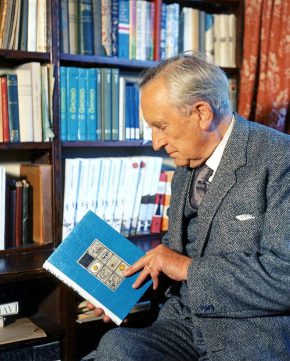 Celebrate Tolkien Reading Day on the Anniversary of the Destruction of the One Ring! All are encouraged to celebrate by reading something by Tolkien.
This year's theme is Nature and Industry. I'm reading "Leaf by Niggle." For more info, visit:
https://www.tolkiensociety.org/2020/03/today-is-tolkien-reading-day-3/?fbclid=IwAR0IRlvhtKo0byig6FNgMHxklW1KePaVGI20RZIktf5-mBr_SkD_0LqI1ZU
And to hear something appropriate from the Professor himself, listen to Tolkien reading Treebeard's song at https://www.youtube.com/watch?v=WO7QRVqLv40.
More links to Tolkien reading at https://sites.google.com/site/tolkiensartmythsandsources/links/music-and-audio-recordings
Feel free to listen and let us know what you think here to count as a comment for this week's blog requirement.
Medieval Medical Theory and Middle Earth Part 2: Doctrine of Signatures and the King's Touch
Welcome to Medieval Medicine Part 2: Electric Boogaloo! Kidding aside, this next facet of medieval medicine is rather curious. The doctrine of signatures was the idea that “like cures like”; that is, ailments concerning a certain body part or organ could be cured by an herb that looks like said body part. While this was first developed in the West by the Romans, this concept could be found in the traditional medicine practices of many cultures around the world. While ludicrous sounding today, determining the efficacy of a medicine back then was trial and error (case in point, Egyptians putting moldy bread on wounds without knowing what penicillin was). Thus, the idea that God or a higher power created plants to look like the body part probably was reassuring to the healer debating whether a berry was poisonous or not.
The doctrine of signatures ties in perfectly with athelas and Aragorn. As noted in The Return of the King, “Come athelas! Life to the dying in the king’s hand lying!” (Tolkien 1955). This suggests that the full healing effect of athelas is brought about when used by the king, providing an important connection with the herb and Aragorn. In addition, in regards to literal similarities, athelas is considered to be nothing more than a weed, having a pleasant smell but not pretty to look at. Only when it is put to its true purpose of healing does the plant live up to its name of kingsfoil. In a similar fashion, when Frodo and the company first meet Aragorn, he appears more of a potential foe than a kingly ally. However, as the story progresses Aragorn begins to take up the mantle of leadership, exposing his true nobility. Thus, the doctrine of signatures aids in both reinforcing and foreshadowing Aragorn’s development through a healing herb.
As a final note, the idea of the hands of a king having a greater healing effect harkens back to the king’s touch, the idea that God had bestowed healing power to the royal house, thus legitimizing their reign. Thus, Aragorn’s enhanced healing abilities with athelas not only makes perfect sense, but it is also an intriguing historical parallel.
Tuesday, March 24, 2020
Medieval Medical Theory and Middle Earth Part 1: The Four Humors and Frodo’s Wound
In the midst of what should have
been another Roaring 20’s which has instead become a pandemic (seriously, can
big band music at least come back to offset these terrible times?), what better
way to tie it into class but to explore the parallels between medieval medical
theory and the moments of healing shown in Tolkien’s works?
Perhaps one of the most central and well-known
concepts from medieval medicine is the idea of the four humors, which actually
was borrowed from the Greek and Romans. Composing of blood, phlegm, bile, and
black bile, each had properties of either hot or cold, wet or dry. Blood
(sanguine) is hot and wet, phlegm is wet and cold, black bile is dry and cold,
and bile is hot and dry. Illness is caused by imbalance among these four
humors, with the remedy oftentimes being giving the patient the exact opposite
humor. For an explanation from an anime (yes, you read that right), watch the
following clip: https://www.youtube.com/watch?v=GBdXpnM-M38
The
explanation starts at 3:40 until 5:00 by the way; apologies for the quality in
advance.
Now, what does this have to do with The
Lord of the Rings? Well, Frodo is stabbed by the Morgul blade, which causes
him to become cold. In addition, the illness is similar to the Black Breath of
the Ringwraiths, which from the name alone suggests a dry nature. Given this,
what is Aragorn’s temporary treatment of the wound? Bathing it with boiled
water with Athelas leaves, a mixture of hot and wet. Stay tuned, as a future
post will dive into the Doctrine of Signatures and the King’s Touch in relation
to Aragorn!
Springtime and Imagery
One
thing I really enjoyed about Sir Gawain and the Green Knight was the level of description and imagery that accompanied every section of the story. We were given descriptions of people, clothing, places, landscapes - every description given just as much as importance as the last. My favorite lines (or at least the ones that resonated most as I was reading it) were these:
“but then the weather in the
world makes war on the winter,
cold creeps into the earth,
clouds are uplifted,
shining rain is shed in
showers that all warm
fall on the fair turf,
flowers there open,
of grounds and of groves
green is the raiment,
birds are busy a-building
and bravely are singing
for the sweetness of the
soft summer that will soon be on the way:
and blossoms burgeons and blow
in hedgerows bright and gay;
then glorious musics go
through the woods in proud array.”
This
seemed very appropriate for the weather outside my house today. Among all the
stresses of the week, it's nice to stop and notice the world moving through such
familiar motions and see that things continue on being beautiful and warm and
connected even when we may feel disconnected and worried.
What
were your favorite descriptions from Sir Gawain? And why do you think
the author chose to put as much time into describing the landscape and the field-dressing
of the hunted animals as they put into the descriptions of people and actions?
Sunday, March 22, 2020
COVID-19 in Middle Earth
Hey everyone!
This is just a fun little exercise I thought might be interesting. I was wondering how the members of the fellowship would react to a pandemic (I am putting this before the events of LOTR).
My thought was that Frodo and Sam would probably limit their social interaction just a little, but in the end would still go out and spend time with friends for the most part. Merry and Pippin wouldn't change their habits at all. Merry might try to convince Pippin that they should, but eventually would agree that everyone's reactions are a bit extreme. Gandalf would probably be the one running around warning everyone and would end up getting the virus himself. Aragorn would probably find disappear into the wild until it was over, he might help Gandalf warn people for a while though. Boromir would be out preaching to his people that they needed to remain isolated and spreading the news through Gondor. He would also end up with the virus which would most likely kill him. Gimli would help the dwarves isolate their entire community so no one could get in or out and spread the virus. The dwarves would escape unscathed. I also think Legolas would do something similar and the elves of Mirkwood would be untouched by the virus. This is just what I thought they might do. Please comment down below and let me know what you think they would do!
This is just a fun little exercise I thought might be interesting. I was wondering how the members of the fellowship would react to a pandemic (I am putting this before the events of LOTR).
My thought was that Frodo and Sam would probably limit their social interaction just a little, but in the end would still go out and spend time with friends for the most part. Merry and Pippin wouldn't change their habits at all. Merry might try to convince Pippin that they should, but eventually would agree that everyone's reactions are a bit extreme. Gandalf would probably be the one running around warning everyone and would end up getting the virus himself. Aragorn would probably find disappear into the wild until it was over, he might help Gandalf warn people for a while though. Boromir would be out preaching to his people that they needed to remain isolated and spreading the news through Gondor. He would also end up with the virus which would most likely kill him. Gimli would help the dwarves isolate their entire community so no one could get in or out and spread the virus. The dwarves would escape unscathed. I also think Legolas would do something similar and the elves of Mirkwood would be untouched by the virus. This is just what I thought they might do. Please comment down below and let me know what you think they would do!
Subscribe to:
Posts (Atom)